I asked Claude Can Claude Code Ship a Huge Project With No Coding
Claude Code can ship small apps for non coders, but a huge project needs engineering judgment. See where the line sits and where to get help.
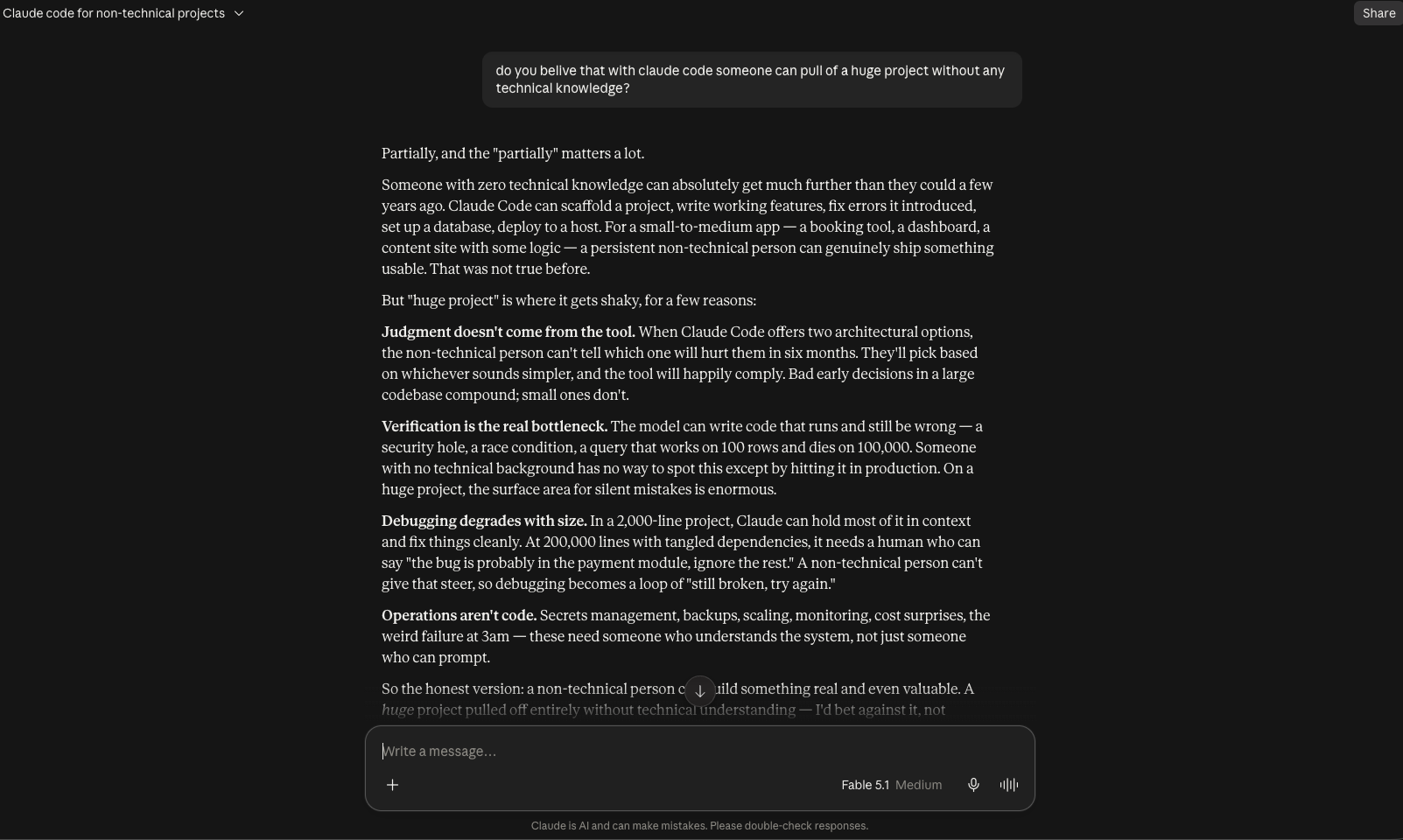
The question I typed at two in the morning
I had a cold coffee going flat next to me when I finally typed the thing I had been chewing on for weeks. Can someone pull off a huge project with Claude Code and no technical knowledge at all? I build software for a living, so this is not idle curiosity for me. I ship web apps, AI systems and backends for real businesses out of Dhaka, and almost every week a founder lands in my inbox carrying the same quiet hope. The screenshot at the top is that exact chat. The answer that came back was not a clean yes, and it was not a flat no.
It was partially. And that one word does a lot of heavy lifting.
Why partially is the only honest answer
Something genuinely shifted in the last two years. A person with zero background can now get much further than they could before, and it is not close. Claude Code will scaffold a project, write features that actually run, fix the errors it just introduced, wire up a database, and push the whole thing to a host. That used to be a wall. It is a ramp now.
Small and medium builds really did open up
A booking tool. An internal dashboard. A content site with a bit of logic behind it. A persistent non technical person can ship one of those and have it work, on a real domain, with real users. I have watched founders do it. When someone asks me whether coding without coding is real, my honest reply is that for a contained app, yes, it is finally real.
Then the word huge shows up
The trouble starts exactly where the ambition scales. A large project is not a small project with more files. It is a different animal, and it fails in ways that a prompt cannot see coming. This is the part the excitement usually skips over, so let me slow down on it.
The four walls a non technical builder hits
When I read the reply from Fable, it named the same four failure points I would have written on a whiteboard. Not because the tool is weak. Because these are human problems wearing a technical costume.
Judgment does not ship inside the tool
When Claude Code offers you two ways to structure something, it will build whichever one you pick and never argue. A non technical person cannot tell which choice quietly hurts them in six months. So they pick the option that sounds simpler, and the tool happily complies. In a small codebase a bad early call costs you an afternoon. In a large one it compounds, and you feel it long after you forgot you made it.
Verification is the real bottleneck
Here is the uncomfortable truth. Code can run perfectly and still be wrong. A security hole that stays quiet. A race condition that only shows up under load. A query that flies on 100 rows and dies on 100,000. Someone with no technical footing has no way to catch any of that except by hitting it live, in front of users. On a huge project the surface area for silent mistakes is enormous, and Claude Code will not flag what it does not know to look for.
Debugging gets harder as the code gets bigger
In a 2,000 line app, the model can hold most of the thing in its head and fix cleanly. At 200,000 lines with tangled dependencies, it needs a human who can say the bug is almost certainly in the payment module, ignore the rest. A non technical builder cannot give that steer, so debugging turns into a loop of still broken, try again that burns hours and confidence in equal measure.
Operations are a whole separate craft
Secrets management. Backups. Scaling. Monitoring. The cost surprise on the invoice. The failure at three in the morning that wakes nobody because nobody set up an alert. None of that is code you can prompt your way through. It needs someone who understands the running system, not just someone who can describe a feature.
The tool removed the barrier to writing code. It did not remove the need to understand what the code is doing, and on a large system that gap is where projects quietly bleed out. If you want a sense of how fast that bleed can start, I wrote about it in more detail across my other posts.
What I actually tell founders who ask me this
I never tell them to stop. That would be dishonest, and a little arrogant. I tell them to ship the small version themselves with Claude Code, prove the idea, feel the product in their own hands. That part is theirs, and it is genuinely valuable now. Roughly 80 percent of an early stage idea can get validated this way before a single engineer touches it.
Then, before the thing turns into the huge project they are dreaming about, bring in judgment. Not to take it away from them, but to review the architecture, harden the security, and own the operations. That is the exact seam where the projects I take on tend to begin. Someone built something real, it started to matter, and it outgrew the tool that birthed it. There is no shame in that. It is the natural life cycle of a good idea.
Frequently asked questions
Can a non technical person build an app with Claude Code?
Yes, for small to medium apps. A booking tool, a dashboard, or a content site is well within reach today. The tool scaffolds, codes, and deploys. The limit is not building the first version, it is verifying and maintaining it once real users show up.
What is the biggest risk of building a large project this way?
Silent correctness bugs. Code that runs but is still wrong, a security gap or a query that breaks at scale. A non technical builder often only discovers these in production, where they are most expensive. On a big codebase the odds of one hiding somewhere climb fast.
Does Claude Code write secure code by default?
It writes reasonable code, but it cannot promise security. It does not know your threat model, your data sensitivity, or your compliance needs unless you do. Security review is a human judgment call, and it is one of the first things I check when a fast built app starts handling real user data. A Stanford study even found developers using an AI assistant tended to write less secure code while feeling more confident it was secure — which is exactly why that human review matters.
When should a non technical founder bring in an engineer?
The moment the project starts to matter. When it holds real user data, real money, or real reputation. Ship your proof of concept solo, then get an engineer for architecture, security, and operations before you scale. That handoff point is where most healthy projects find me.
Can Claude Code maintain a huge codebase on its own?
Not reliably. As a codebase grows past a certain size, the model can no longer hold the whole thing in context, and debugging degrades without a human to point it at the right module. Maintenance at scale still needs someone who understands the system as a whole.
Where to take this next
So here is my honest version, the same one I gave that chat window at two in the morning. A non technical person can build something real and even valuable with Claude Code, and that alone is a quiet revolution. A truly huge project pulled off with zero technical understanding, start to finish, I would still bet against it, and not by a small margin. The tool is the easy part now. The judgment is the whole game.
If you have built the small version and it is starting to outgrow you, that is a good problem, and it is exactly the kind I like. Take a look at what I build, browse the work I have shipped, or see how I work with teams over on my career page. And when you are ready to make the idea solid, tell me what you are building. I would love to hear where you are stuck.