AI / ML · NLP
Law Suggestion using ML
An NLP tool that takes an everyday description of a situation and points the person toward the legal references most likely to apply, lowering the barrier to understanding your rights.
- Role
- ML engineering
- Client
- Research & product
- Timeline
- Prototype
- Year
- 2023
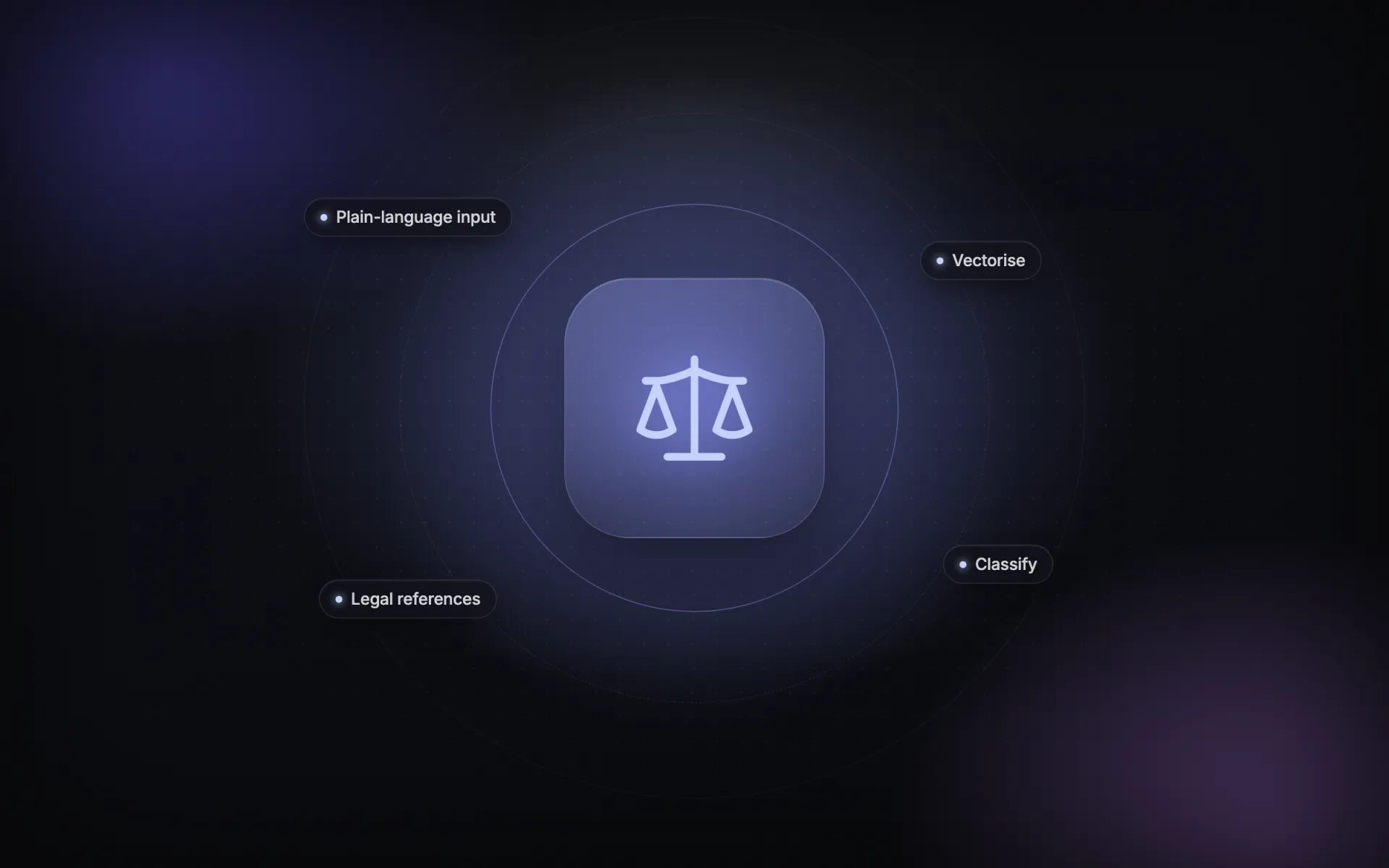
Plain-language input, legal-reference output
A classic NLP pipeline: clean, vectorise, classify
Built to be explainable, not a black box
Overview
Most people do not know which law applies to their situation, and legal language is exactly the part they cannot parse. This project bridges that gap: describe what happened in ordinary words, and the model suggests the legal references most relevant to it.
The challenge
Everyday phrasing is messy and rarely uses legal terminology, so the model had to learn the mapping between how people describe problems and how the law categorises them, with enough transparency that a suggestion can be sanity-checked rather than blindly trusted.
Approach
I built a classic, explainable NLP pipeline in Python: text cleaning, vectorisation, and a trained classifier over labelled examples, deliberately favouring approaches whose behaviour can be inspected over an opaque end-to-end model for a domain this sensitive.
Outcome
The prototype demonstrates a genuinely useful pattern: turning a plain-language account into a shortlist of relevant references, as a starting point for someone to research further or take to a professional.
Key features
Takes an everyday description and returns relevant legal references
Text cleaning and vectorisation pipeline in Python
A trained, inspectable classifier over labelled examples
Explainable by design for a sensitive domain
Built with
Have a project like this?
I take products from first sketch to shipped, design, build, and the AI in between. Tell me what you’re working on.