Milestone Payments for Software Projects, Pay 25% at a Time
Milestone payments for software projects, done fairly: pay 25% only after each 25% of the work is finished. No deposit. See how the 4 × 25% model works.
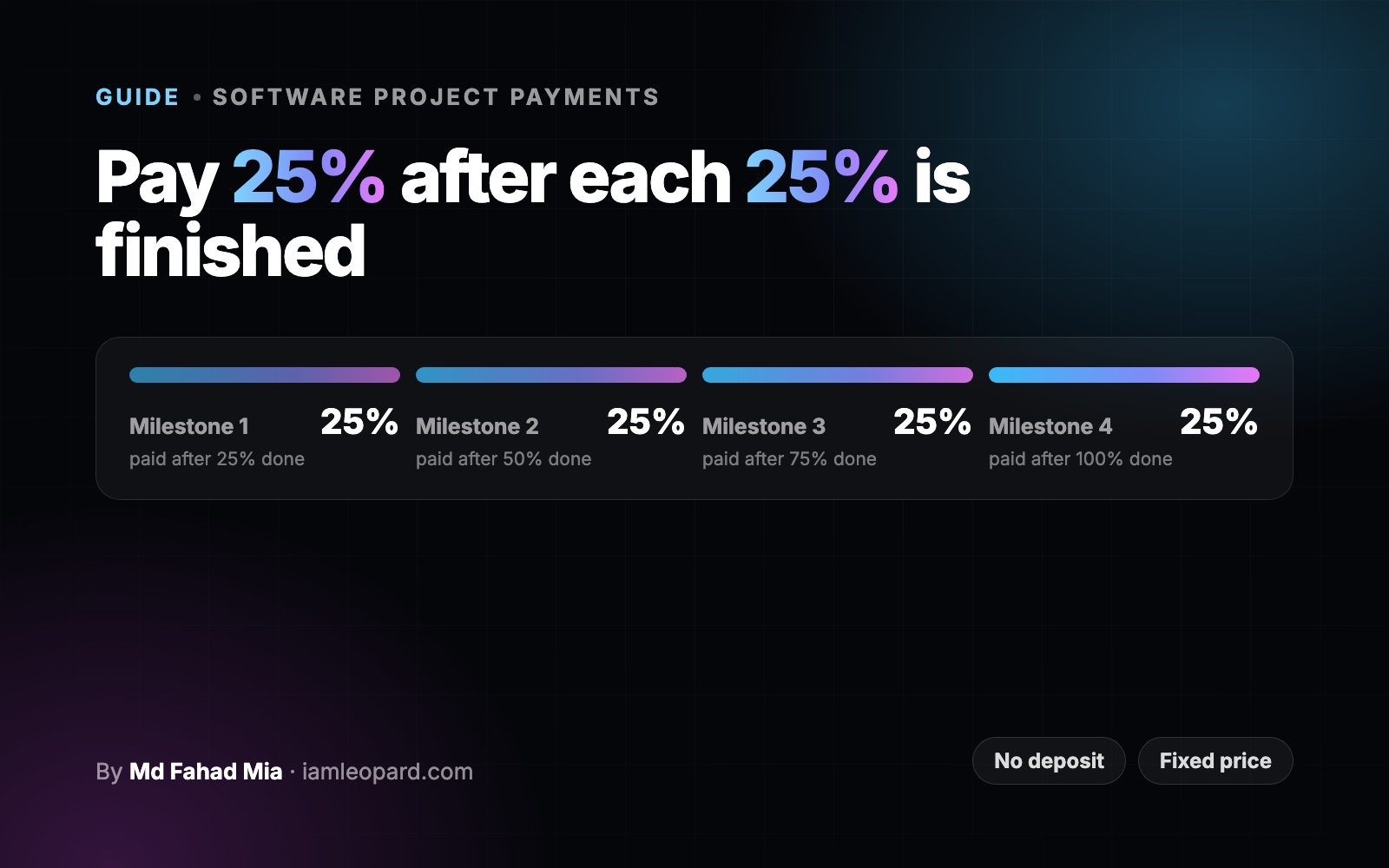
The short answer: I split every fixed-price project into four milestones of equal value. When the first 25% of the work is finished and you have reviewed it, I invoice 25% of the price. Then the next 25%, and the next, until the fourth milestone ships with the launch and the handover. There is no deposit. You never pay for work you have not seen.
I am Md Fahad Mia, a software and AI engineer based in Dhaka, and I build web apps, backends and AI features for companies in Europe, the UK, the US and the Middle East. This post explains how the 4 × 25% model works, why the usual payment terms push the risk onto the client, and how to tell whether milestone payments fit your project.
Why the usual payment terms put the risk on the client
Most software contracts ask for money before anything exists. The client pays for a promise and hopes the software arrives. Here is how the common structures compare on the question that matters: what have you actually seen at the moment you pay?
| Payment structure | When you pay | What you have seen when you pay | Who carries the risk |
|---|---|---|---|
| 50% up front, 50% on delivery | Half before work starts, half at the end | Nothing, then everything at once | The client, for the whole first half |
| 30 / 40 / 30 | 30% up front, 40% midway, 30% at the end | Nothing at first, a partial build midway | Mostly the client |
| Hourly (time and materials) | Every week or month | Hours spent, not outcomes | The client, whenever the estimate slips |
| Platform escrow milestones | Funded before each milestone starts | Nothing yet, the platform holds the money | Shared, with platform fees on top |
| 4 × 25%, paid after each milestone | After each quarter of the work is finished | A working preview of that quarter | Mostly the engineer |
Both sides have good reasons to be nervous. Engineers ask for deposits because late and missing payments are common. In the UK, a GoCardless and Federation of Small Businesses survey found that 45% of small firms had more late payments than a year earlier, and the UK government puts the cost of late payment at £11 billion a year. Clients worry about the opposite problem: software that arrives late and over budget. A McKinsey and University of Oxford study of more than 5,400 IT projects found that large ones ran 45% over budget on average and delivered 56% less value than predicted.
Most payment terms settle that tension by putting the risk on the client. On a platform like Upwork, for example, the client funds each milestone before work on it starts. Governments decided long ago that this is the wrong way round for buyers. HM Treasury's Managing Public Money tells UK public bodies that paying in advance of need should be exceptional, and the Scottish Public Finance Manual says interim payments should follow "value received and delivery of tangible outputs". Paying after each finished milestone applies the same rule to a private project.
How the 4 × 25% model works, step by step
- Scoping call and written plan. We agree the outcome, the fixed price and four milestones of equal value. Each milestone gets written acceptance criteria: what you will be able to click, run or test when it is done.
- Milestone 1, foundations. Data model, architecture and the first working slice, deployed to a preview link. You review it against the criteria. Then I invoice the first 25%.
- Milestone 2, core features. The main workflows run end to end on real or realistic data. Reviewed, then 25%.
- Milestone 3, integrations and hardening. Payments, AI features, third-party APIs, access control and monitoring. Reviewed, then 25%.
- Milestone 4, launch and handover. Production deployment, documentation, and everything moved into your repositories and cloud accounts. The final 25%.
The labels change from project to project. On an AI automation, milestone three might be the evaluation of the model's answers against your real cases. On a mobile app it might be store submission. The rule does not change: four equal quarters, each one finished and reviewed before it is paid.
What that looks like in numbers
| Project type | Starting price | Each of the four invoices |
|---|---|---|
| AI and automation build | $5,000 | $1,250 |
| Mobile app | $6,000 | $1,500 |
| Web application | $3,500 | $875 |
| Backend and API | $3,000 | $750 |
These are the starting prices listed on my services page. Your fixed price is set after the scoping call, and the arithmetic stays the same: the total divided into four equal invoices, each one sent only after its milestone is done.
What "finished" means
Milestone payments only work when both sides agree on what finished looks like, so that is written down before I start. A milestone is finished when its acceptance criteria are met on a working preview you can use yourself. Not a slide, not a screenshot, not a status report.
If something in the criteria is missing or broken, I fix it before the invoice goes out. If you want something that was not in the plan, that is a change, and it is written down and priced on its own, so the four milestones stay fair to both of us. Scope changes are normal. Scope changes nobody wrote down are how projects go sour.
The question a payment schedule should answer is simple: at the moment you pay, what have you seen working? With 4 × 25%, the answer is always the quarter you are paying for.
Why I carry the risk, and why it works
- It forces good scoping. If I cannot describe the first quarter clearly enough to be paid for it, the plan is not ready, and it is far cheaper to learn that before the build than halfway through it.
- It keeps projects calm. You get four check-ins with working software instead of one big reveal at the end. That rhythm is the whole idea behind how I keep freelance projects calm.
- Your exposure stays at zero. At any point in the project, the only unpaid work is mine. You never have money sitting against software that does not exist yet.
- You can stop after any milestone. If priorities change, you have paid only for finished quarters, and you keep that work in your own repository.
It also filters for the right kind of client relationship. People who want to see progress before paying, working with an engineer who is confident enough to be paid on delivery. The Tryneth backend and the other case studies show the kind of work that gets delivered this way.
Paying from Europe or the UK
A large share of the companies that look for a remote engineer are in the EU and the UK, so a few practical notes for them. Your accountant has the final word on your own case.
- VAT. For business clients, services bought from a supplier outside the EU are taxed where the customer is established (Article 44 of the VAT Directive), and the customer accounts for the VAT under the reverse charge (Article 196). My invoices carry no EU VAT, and your finance team self-accounts for it. UK businesses do the same under HMRC's reverse charge for services from abroad.
- Payment terms. The EU Late Payment Directive sets 30 days as the default for business invoices when the contract says nothing else. Four smaller invoices spread across the project sit inside normal finance cycles much more easily than one large bill at the end.
- Payment methods. Bank transfer, Wise, or card through Stripe.
- Personal data. If the project touches customer data, we sign a GDPR data processing agreement with Standard Contractual Clauses before I get access. I cover that in detail in hiring a remote developer in Europe and GDPR-compliant LLM integration.
When milestone payments are not the right fit
- Ongoing work. Maintenance, DevOps and product work with no fixed end run better as a monthly retainer, billed monthly.
- Open-ended research. When nobody can yet say what done looks like, start with a short architecture engagement that ends in a written plan. The build that follows can then run on four milestones.
- Very large programmes. Several products in parallel need a team, not one engineer, whatever the payment schedule. I explain when an agency is the better call in forward deployed engineer or agency.
Questions about milestone payments
Do you take a deposit before starting a project?
No. The first invoice goes out only when the first 25% of the work is finished and you have reviewed it on a working preview. Each of the next three invoices follows the same rule, so nothing is paid up front on any fixed-price project.
What happens if a milestone is not what we agreed?
It is checked against the acceptance criteria written into the plan before work started. If anything in those criteria is missing or broken, I fix it before invoicing. New ideas that were not in the plan are written up as a change with their own price, so the four milestones stay fair.
Are the four payments always exactly 25% each?
Yes. The plan is built so each milestone carries a quarter of the project's value, which keeps the invoices equal and predictable. A $5,000 project is four invoices of $1,250, a $3,500 project is four of $875.
Can I stop the project after a milestone?
Yes. You will have paid only for the milestones that are finished, and you keep that work in your own repository. It rarely happens, but knowing you can is part of why the model feels safe to buy.
Does the 4 × 25% model apply to monthly retainers?
No. It applies to fixed-price projects such as web builds, backends, AI and automation, mobile apps and e-commerce. Retainers for ongoing backend, DevOps or monitoring work are billed monthly.
How do companies in Europe and the UK pay the milestone invoices?
By bank transfer, Wise, or card through Stripe. For business clients in the EU and the UK, services from a supplier outside those regions are generally handled under the VAT reverse charge, so your own finance team accounts for VAT. Check the details with your accountant.
Want a project where you only pay for finished work
If you have a build in mind and would rather see progress than pay for promises, start with a scoping call. You get a written plan with four milestones and a fixed price, and you decide from there. See what hiring me looks like, or start a project today.
Prices for every service are on the services page, and the case studies show what gets shipped. I read and answer every message myself.