Which LLM Providers Store EU Data for a GDPR Compliant LLM
A GDPR compliant LLM keeps your EU customer data secure. Learn which providers offer European residency and how to configure your API today.
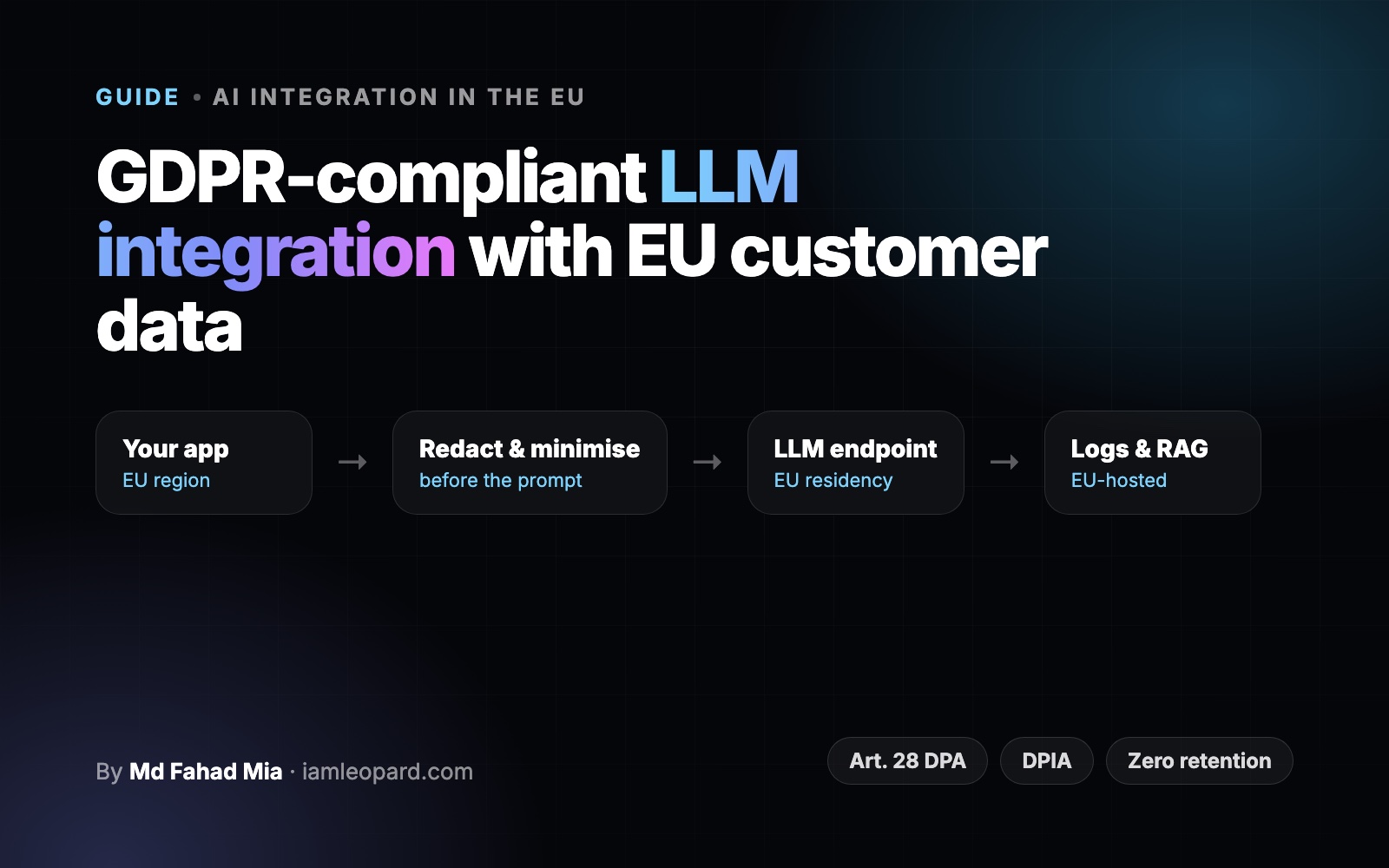
Which providers give you a GDPR compliant LLM?
Mistral AI is the most direct foundation for a GDPR compliant LLM because it hosts data in Europe by default. Other major providers like OpenAI, Google Gemini, and Microsoft Azure offer strict European data residency options for their APIs, but they require specific configuration. You can safely use large language models with the personal data of European customers if you get a few core things right. You need a lawful basis for the processing and a signed processor contract with the AI company. You also need an EU-region endpoint to keep the processing local, so send as little personal data in each prompt as the task allows. Run a DPIA when the use is likely to be high risk. Most data protection trouble with AI features comes from your own logs, prompts, and retention settings rather than the model itself.
I am a software and AI engineer who integrates these models into production products, and I recently built the backend of an AI marketing and CRM platform with five orchestrated agents. This guide is the practical version of those lessons. Here is what the providers actually offer as of September 2026. Since I am an engineer rather than a lawyer, always have your data protection officer or counsel sign off on your specific case.
Where each AI provider keeps your data
Data residency options have shifted heavily in two years, and they are not the same across providers. Here is where each one stood when I checked their documentation in September 2026.
| Provider | EU processing option | Retention and training |
|---|---|---|
| OpenAI | EU data residency since February 2025 for the API, ChatGPT Enterprise and Edu, through the eu.api.openai.com endpoint. It requires approval for zero data retention or modified abuse monitoring. | API data has not been used for training by default since 1 March 2023. Abuse-monitoring logs are kept for up to 30 days by default. |
| Anthropic (Claude) | No first-party EU residency on the Claude API itself, which offers global or US processing. EU processing is available through Amazon Bedrock EU inference profiles or the EU endpoint on Google Cloud Vertex AI, at roughly a 10% premium. Claude on Microsoft Foundry has no EU option yet. | Commercial API inputs and outputs are deleted within 30 days by default, and commercial customer content is not used for training. Zero data retention is available by arrangement. |
| Google (Gemini on Vertex AI) | The EU multi-region endpoint keeps machine-learning processing inside EU member states. The UK and Switzerland are not included, and the global endpoint gives no residency guarantee. | Governed by your Google Cloud terms and data processing addendum. |
| Microsoft (Azure OpenAI) | Data Zone EU deployments process data within the EU Data Boundary. Global deployments may process data in any region. | Governed by your Azure terms and data processing addendum. |
| Mistral AI | Headquartered in Paris. Data is hosted in the EU by default, and the US endpoint is opt-in. | Some features may pass data to listed sub-processors under Standard Contractual Clauses. |
Two practical notes matter here. First, the region you pick in code has to be the region you actually get. A client library that silently falls back to a global endpoint during an outage breaks your residency promise without anyone noticing, so I make the region explicit and tell the app to fail closed instead. Second, these options change often. Always re-check them before you sign a contract rather than after.
Legal requirements for DSGVO and GDPR compliance
Contracts and legal bases form the foundation of any compliant AI feature, because technical safeguards mean nothing if your paperwork fails.
Lawful basis and processor contracts
Every use of personal data needs a lawful basis. For a support assistant, it is often the contract with the customer or a legitimate interest, which requires a documented balancing test. The model provider processes data on your behalf, so Article 28 requires a written data processing agreement. The business terms of the major providers include one, but consumer accounts do not belong anywhere near customer data.
International transfers and high risk processing
US providers can rely on the EU-US Data Privacy Framework, which is still valid. The General Court dismissed the Latombe challenge in September 2025, and an appeal is pending. Keep Standard Contractual Clauses as a fallback, and remember that engineers and contractors outside the EU need SCCs too, which I cover in hiring a remote developer in Europe. Article 35 requires a data protection impact assessment where processing is likely to be high risk. Systematic profiling with significant effects on people is one example, while large-scale processing of health and other special-category data is another.
Preparing enterprise data for LLM development
How do companies in Europe prepare company data for LLM development? They strip it down first. If you fine-tune a model on customer data, the EDPB's Opinion 28/2024 applies, and whether a model counts as anonymous is judged case by case. Unlawful processing during development can easily taint its later use. Article 22 gives people the right not to be subject to decisions based solely on automated processing that have legal or similarly significant effects, so keep a human in the loop for anything like that.
The stakes are high. Breaches of the core principles, of Article 22 or of the transfer rules can reach €20 million or 4% of worldwide turnover, whichever is higher. Failures under Articles 25, 28 and 35 sit in the lower tier of €10 million or 2%.
Build patterns that keep personal data safe
This is where most of the real work happens. Contracts cover you on paper, but these technical patterns decide what actually happens to your customers' data in production.
- Minimise before the prompt. Send only the fields the task needs. Replace names, emails, phone numbers and account IDs with placeholder tokens before the call, and swap the real values back into the answer later. The model can reason about "Customer A's order" just as well as a real name. This is Article 5(1)(c) data minimisation applied where it counts.
- Pin the region and fail closed. Configure the EU endpoint explicitly per environment. Make the integration refuse to run rather than fall back to a global region.
- Turn retention down. Use zero data retention where the provider offers it and your use qualifies. Next, look at your own stack because full prompts sitting in an observability tool, an error tracker or a debug log are the most common leak I find. Redact them or keep only metadata with short retention.
- Keep retrieval in the EU and behind permissions. For retrieval-augmented generation, store embeddings in an EU-region database such as Postgres with pgvector. Enforce the same access rules as the rest of the app. On the Tryneth backend, row-level security covered 97 of 98 tables, meaning the AI could only retrieve what the signed-in user was allowed to see.
- Make deletion reach the AI layer. When a customer asks to be erased, their data has to disappear. Clean out conversation logs, caches and embeddings alongside the main database. Design for that on day one, because retrofitting it is painful.
- Human review for consequential outputs. Anything that affects a person's money, access or opportunities goes to a human before it takes effect.
- Tell people. Your privacy notice should say that AI is used and which provider processes the data. Your interface should also say when they are talking to an AI, as the EU AI Act has required since August 2026. More on that in what the EU AI Act means for small businesses.
The model is rarely where GDPR goes wrong. The prompt, the log and the retention setting are.
We design these safeguards directly into our AI and machine learning projects so compliance is built in from the start. You can explore the technical details in our guide to GDPR compliant LLM integration.
A pre-launch checklist for AI features
Before you ship, verify these technical and legal controls are active.
- Lawful basis documented for each AI use.
- Data processing agreement signed with the model provider. SCCs or the Data Privacy Framework covering any transfer.
- EU endpoint pinned, with no silent fallback.
- Personal data minimised or pseudonymised before each prompt.
- Zero or minimal retention configured, and prompt logging redacted.
- Vector store and conversation logs in an EU region, behind the app's access rules.
- Erasure requests reach logs, caches and embeddings.
- DPIA done if the use is likely to be high risk.
- Human review in place for consequential decisions.
- Privacy notice and AI disclosure updated.
Questions about GDPR and LLMs
Can I use the OpenAI API with EU customer data under GDPR?
Yes, with the right setup. Use a business account with OpenAI's data processing agreement. Configure its EU data residency option through the eu.api.openai.com endpoint, minimise personal data in prompts, and document your lawful basis. API data has not been used for training by default since March 2023.
Does Claude offer EU data residency?
Not on Anthropic's own API as of September 2026, which offers global or US processing. For EU processing, run Claude through Amazon Bedrock EU inference profiles or the EU endpoint on Google Cloud Vertex AI. This usually carries around a 10% price premium, but commercial Claude API data is not used for training.
Do LLM providers train on data sent through their APIs?
Not by default for business API use at the major providers. OpenAI has not trained on API data by default since 1 March 2023, and Anthropic does not train on commercial customer content. Consumer chat apps are a different matter entirely, which is why customer data belongs only in business accounts.
Do I need a DPIA for an AI chatbot?
Not always. Article 35 requires one when processing is likely to result in a high risk, such as systematic profiling with significant effects or large-scale processing of health data. A support bot that sees order numbers is often below that bar, but many companies run a light DPIA anyway because it documents the design choices.
Is the EU-US Data Privacy Framework still valid in 2026?
Yes. The General Court dismissed the Latombe challenge in September 2025, and the appeal to the Court of Justice is pending. Because the framework could still fall, it is sensible to keep Standard Contractual Clauses in place as a fallback for US providers.
Is Mistral the safest choice for GDPR?
It helps, because Mistral is based in Paris and hosts data in the EU by default. But residency is only one factor. Minimising what goes into prompts, controlling retention and logging, and signing the right contracts matter just as much with any provider, including an EU one.
How do I make an LLM API compliant with GDPR?
Making a GDPR compliant LLM API requires a signed data processing agreement. You must enforce an EU region endpoint in your code, strip personal data before you send the prompt, and keep retention periods as short as possible.
Adding AI to a product that serves Europe
If you want an AI feature that your data protection officer will sign off on, start with a scoping call. You will get a written plan that names the provider, the region, the data flows and the safeguards, and we work with a fixed price across four milestones you pay for only once each is done, which you can read about in our approach to milestone payments for software projects.
See what hiring me looks like, explore our full services overview to see how we build. You can review our AI and machine learning hub, check open roles on our career page, or start a project today.